Birmingham Civil Rights National Monument, Alabama. All photography is ours.
Home/National parks/Alabama
Alabama National Parks
From America’s civil rights struggles to impressive natural beauty, Alabama’s National Parks have a lot to offer. Come #FindYourPark in Alabama.
National parks guide · Updated October 2026
Every NPS site in Alabama
9
National Park Service sites in Alabama
There are nine National Park Service sites in Alabama: three national monuments, two national historic sites, a national military park, a national preserve, a national scenic trail, and a parkway. Tap any of them to jump to its details.
At a glance
We’ve been · 1 of 9
Affiliated sites · 4
0national parks
No national parks in Alabama yet
We’ve beenNot yet
National Park Service sites 9
Birmingham Civil Rights National Monument
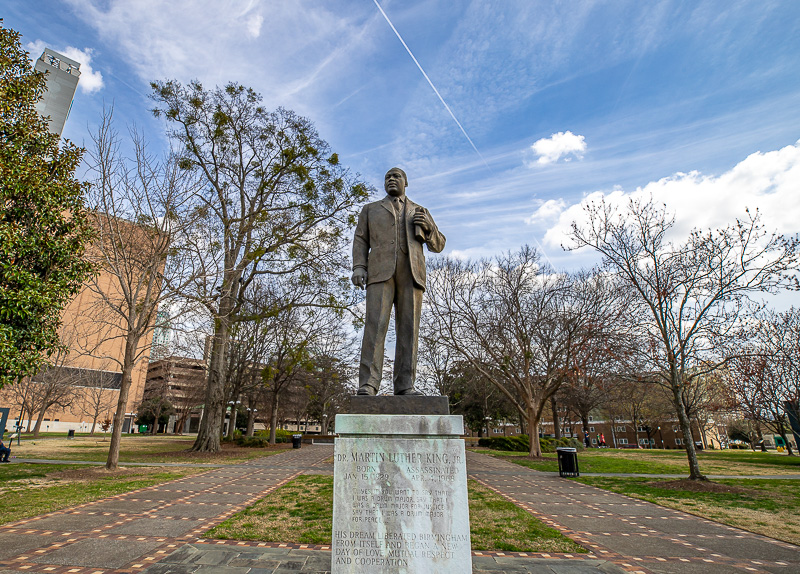
The Birmingham Civil Rights National Monument highlights the police aggression that took place on the streets of Birmingham in 1963 against nonviolent protesters. Scenes of police dogs being let loose on Black citizens and crowds being sprayed with high-powered fire hoses were seen all over the world and brought attention to the social injustice in America at the time. As public outrage grew, it pushed Congress to pass the landmark Civil Rights Act of 1964.
Sites at the national monument include the 16th Street Baptist Church, which was bombed in a terrorist attack, and the Birmingham Civil Rights Institute. President Barack Obama established the monument in 2017, and it’s still being developed to include more sites in and around the Birmingham Civil Rights District.
Freedom Riders National Monument
In 1961, bus terminals across the South were still segregated, even though the Supreme Court had ruled against segregation in interstate travel. The Freedom Riders set out to end the practice by riding buses through the South and drawing attention to segregated bus terminals and facilities, just as protesters had done at lunch counters and restrooms. White segregationists frequently attacked them, but it wasn’t until photos of a firebombed bus made headlines that people started paying attention. In May 1961, Attorney General Robert Kennedy petitioned the Interstate Commerce Commission to ban segregation in interstate travel. By November of that year, bus terminals and facilities had to be integrated.
President Barack Obama established Freedom Riders National Monument in 2017, on the same day as the Birmingham Civil Rights National Monument. It preserves the memory of the Freedom Riders and their fight to desegregate interstate bus travel. While the park is being developed, visitor services are limited, but you can visit the Greyhound Bus Station, the bus burning site, the Anniston Memorial Hospital, and the old Trailways Station. Many of these sites are also part of the U.S. Civil Rights Trail.
Horseshoe Bend National Military Park
Horseshoe Bend National Military Park marks the final battle of the Creek War, where Major General Andrew Jackson’s army defeated the Red Stick Creek warriors. The battle took place on March 27, 1814, and made Andrew Jackson a national hero.
Visitors can drive the 3-mile tour road past the battlefield, and the park is also a great place to hike, fish, picnic, canoe, and go horseback riding. The visitor center has exhibits and a 22-minute film on the Battle of Horseshoe Bend.
Little River Canyon National Preserve
Little River Canyon National Preserve covers more than 15,000 acres in northeast Alabama and is part of the southern Appalachians. The preserve is known for its forests, waterfalls, scenic views, and outdoor recreation. Because it sits where the Cumberland Plateau meets the Gulf Coastal Plain, Little River Canyon is home to a highly diverse mix of plants and animals.
Little River Falls is the park’s best-known feature and a popular place to visit, especially in summer when you can wade into the falls and the swimming hole below. Other popular activities include kayaking, rock climbing, fishing, and hiking. Camping isn’t permitted in the preserve, however. Stop in at the Little River Canyon Center for information before you head out on the trail. The scenic drive along the Canyon Rim Parkway is also a very popular way to see the park. Little River Canyon National Preserve was established in 1992.
Natchez Trace National Scenic Trail
Five separate trails make up the Natchez Trace National Scenic Trail, which is managed by the Natchez Trace Parkway. These 60 miles of trail let hikers experience what it was like to travel the Trace on foot, and they show off the beauty of the region. The five sections are Potkopinu, Rocky Springs, Yockanookany, Blackland Prairie, and Highland Rim. The parkway and trails are free to visit. Find trail maps and more information on the NPS website.
Natchez Trace Parkway
The Old Natchez Trace is a historic corridor once used by the Choctaw and Chickasaw people to travel through the region. Later, many different groups used it to cross the difficult terrain. Today, the Natchez Trace Parkway is a 444-mile scenic drive through Alabama, Mississippi, and Tennessee that tells the history of the region.
Along the parkway you can camp, fish, hike, and enjoy nature. Popular stretches include Natchez to Jackson, Jackson to Tupelo, and Tupelo to Tennessee and beyond. The main parkway visitor center is at milepost 266, and other visitor centers are scattered along the route. See the complete list.
Russell Cave National Monument
Russell Cave National Monument near Bridgeport is a unique archaeological site with one of the most complete records of prehistoric cultures in the Southeast. Archaeologists found evidence of almost 10,000 years of people living in and using the cave shelter.
Visitors can’t go inside the cave itself, but guided tours take you to the cave entrance and the shelter. Picnicking and nature watching are popular too. Russell Cave is the third-longest cave in Alabama and one of more than 1,500 caves in the area. No other place in America has more caves per square mile than right here in Alabama.
Tuskegee Airmen National Historic Site
Tuskegee Airmen National Historic Site tells the story of the Tuskegee Airmen before they became famous as the “Red Tails.” Moton Field in Tuskegee is where African American pilots began their flight training, and the site shows how demanding that training was and what these pilots contributed to the war. Two hangars hold aircraft, exhibits, and a film about the Airmen. A scenic overlook and an outdoor walk with more historical exhibits round out the visit.
Tuskegee Institute National Historic Site
Booker T. Washington arrived in Tuskegee in 1881 to lead a new school for African Americans, and he quite literally helped build Tuskegee Institute brick by brick. Its most famous professor, George Washington Carver, specialized in agriculture and unlocked the potential of the peanut, sweet potato, and soybean. The United Negro College Fund and many other advances in education for African Americans also came out of Tuskegee. In 1901, Booker T. Washington became the first African American invited to dinner at the White House.
Places to visit include The Oaks (Washington’s home), the graves of Booker T. Washington and George Washington Carver, and the George Washington Carver Museum. A limited number of ranger-guided tours of The Oaks are offered each day.
Partners of the Park Service
NPS-affiliated sites in Alabama
These sites aren’t run by the National Park Service, but they’re part of the NPS family through national trails and heritage areas.
Alabama Black Belt National Heritage Area
Congress designated the Alabama Black Belt National Heritage Area in 2019. The name refers to the band of dark, fertile soil that runs across Alabama’s midsection, and to the large number of enslaved Africans and African Americans who once lived and worked on the region’s cotton plantations.
The heritage area covers 19 counties and tells the story of the American South, from the meeting of Chief Tuscaloosa and Spanish explorer Hernando de Soto, to the cotton economy built on slavery, to some of the most important events of the civil rights movement. Visitors can explore historic towns, museums, civil rights sites, and plenty of outdoor recreation across the region.
Muscle Shoals National Heritage Area
Muscle Shoals National Heritage Area was established in 2009 to protect the history of northern Alabama along the Tennessee River and to promote its preservation and conservation. The heritage area covers six Alabama counties and is headquartered at the University of North Alabama in Florence.
Cultural highlights include the area’s rich music history, Native American culture, and the industry and culture of the Tennessee River itself. Visitors can explore museums, historic trails, national forests, historic sites, and plenty of outdoor recreation.
Selma to Montgomery National Historic Trail
The Selma to Montgomery National Historic Trail commemorates the 1965 voting rights marches from Selma to Montgomery. On March 7, 1965, about 600 nonviolent marchers set out from Selma to protest the killing of Jimmy Lee Jackson and to demand their right to vote. Alabama state troopers met them at the Edmund Pettus Bridge and attacked them, and many marchers were hospitalized.
The attack, now known as Bloody Sunday, caused outrage across the country. Later that year, President Lyndon B. Johnson signed the Voting Rights Act into law, banning discrimination in voting because of race or color. Several interpretive centers and historic landmarks line the route.
Trail of Tears National Historic Trail
The Trail of Tears National Historic Trail commemorates the forced removal of the Cherokee people from their homes in Georgia, Tennessee, and Alabama to Indian Territory in present-day Oklahoma. More than 16,000 Cherokee were removed in 1838 and 1839. The trail preserves their routes and important sites and shares their stories of suffering, illness, and death.
Good to know
Alabama national parks questions
No. Alabama doesn’t have a national park, but it does have nine National Park Service sites, including Birmingham Civil Rights National Monument, Freedom Riders National Monument, and Horseshoe Bend National Military Park.
There are nine NPS sites in Alabama: three national monuments, two national historic sites, a national military park, a national preserve, a national scenic trail, and a parkway. Four more NPS-affiliated sites, like Alabama Black Belt National Heritage Area, round out the list.
So far we’ve visited Birmingham Civil Rights National Monument.
Keep exploring
National parks in nearby states
There’s more to explore in these nearby states.